A1 Speaking — Daily life
Speaking ordering, errands, and small talk at the A1 level.
10-14 min
estimated duration
14 live questions
diagnostic depth
16 styles
diagnostic variety
5 skills
coverage
Quick challenge warm-up
Try one short trap before the full diagnostic
These rooms match the skill mix of this test and give users a fast win, fail, or rematch moment before they commit to the longer run.
Tone sorter
44s sorter warm-up before the 10-14 min diagnostic.
Bad versus bed vowel contrast
37s minimal pair warm-up before the 10-14 min diagnostic.
Pronunciation sniper
36s pronunciation sniper warm-up before the 10-14 min diagnostic.
The full report still comes from the diagnostic. The warm-up makes the first tap feel lighter and more shareable.
Browse challenge roomsLive diagnostic blueprint
What this test actually checks
The page uses the same question set as the runner. These counts are not marketing placeholders.
Audio choice
2Checks what the user hears, not only what they can read.
Multiple choice
8Good for quick, high-signal diagnostic traps.
Sentence ranking
1Checks whether the user can feel better, okay, risky, and unnatural English.
Typed answer
1Requires recall, not just recognition.
Open response
1Captures active speaking or writing signal.
Sentence order
1Tests sentence construction and word order.
Product-level question styles
Why this feels like a diagnostic, not a school quiz
The runner uses 6 mechanics, but this test exposes 16 learner-facing diagnostic styles such as tone, image vocabulary, listening, ranking, correction, and open production.
Multiple choice
10Choose the best answer from plausible options.
Fast recognition, distractor resistance, and practical accuracy.
Sentence correction
7Find or choose the corrected version of learner-like English.
Self-editing, grammar repair, and translated-phrase detection.
Fill in the blank
5Complete a sentence with the missing word, particle, article, or tense.
Controlled grammar and vocabulary recall inside a sentence.
Image vocabulary
5Use a visual scene to choose the precise word.
Active vocabulary, visual meaning, and word-context fit.
Natural phrase choice
4Pick the sentence or phrase that sounds least translated.
Collocations, phrase memory, register, and native-like usage.
Scenario-based response
4Handle a work, travel, interview, support, or real-life situation.
Practical readiness under a recognizable real-world context.
Dialogue completion
3Choose or produce the line that fits a conversation.
Turn-taking, pragmatics, spoken context, and real-life response choice.
Exam-style task
3IELTS, TOEFL, TOEIC, Cambridge, or PTE-style prompt behavior.
Readiness for structured academic or workplace exams.
Adaptive modes
Pick the right length for the moment
The same diagnostic can run as a full assessment, a quick check, a focused repair, or a proof run after practice.
Full diagnostic
The complete signal for the most reliable report.
6 formats / 5 skills
Quick check
Shorter run for a fast read when the user is not ready for the full test.
6 formats / 5 skills
Grammar focus
A shorter run biased toward grammar signals.
6 formats / 5 skills
Proof run
More pressure from active, audio, and harder prompts.
6 formats / 5 skills
Sample question
Pick the most natural reply: “How's it going?”
What this reveals
Pretty good, thanks — you?
Live question preview
A few report-ready prompts from this test
These are pulled from the same playable diagnostic. The user can see the kind of answer, explanation, and result signal they will get before committing to the full run.
Audio choice
Listening
1. Audio choice / Listening
B1Listen to the fast phrase and choose what it means
What did you hear?
Best answer
Did you get it?
Mini explanation: Didja is a fast casual reduction of did you. The key is hearing the hidden did + you before the main verb.
Report signal: Fast speech is often about reductions, not unknown vocabulary.

2. Multiple choice / Naturalness
A2Choose the sentence a native speaker would actually use
Which sentence sounds most natural?
Best answer
I took a photo.
Mini explanation: In English, the natural collocation is take a photo. Make a photo sounds translated in everyday English.
Report signal: Translated collocations are easy to understand but make English sound less natural.
3. Sentence ranking / Naturalness
B1Rank the sentences from most natural to most translated
You want to talk about a picture you captured on your phone.
Best ranking
1. I took a photo on my phone. 2. I got a photo with my phone. 3. I made a photo on my phone.
Mini explanation: Take a photo is the clean natural phrase. Get a photo can work in limited contexts, while make/do a photo sound translated.
Report signal: Ranking exposes whether naturalness is automatic or whether every option still feels equally possible.
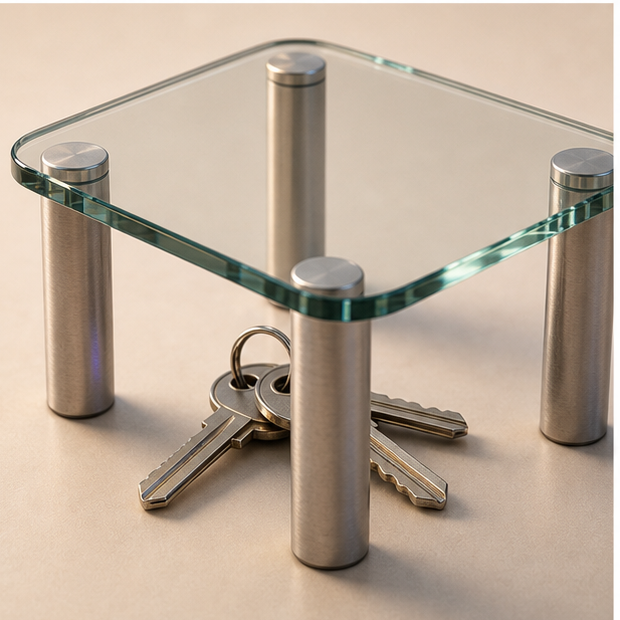
4. Multiple choice / Grammar
A2Choose the preposition with the searching meaning in this sentence
I lost my keys and I am trying to find them. I am looking ___ them.
Best answer
for
Mini explanation: Look for means search. Look at means direct your eyes toward something.
Report signal: Verb plus preposition patterns are a high-signal grammar weakness.

5. Typed answer / Vocabulary
B1Look at the image and type the missing word
The window is ______.
Best answer
shattered / broken / cracked
Mini explanation: Shattered is more precise than broken when glass has broken into many pieces or cracks.
Report signal: Precise visual vocabulary makes English feel sharper and less basic.
Feedback experience
What the user gets after finishing
Skill map
Scores by the exact skills this test touched.
Pattern diagnosis
Repeated weak patterns grouped into readable cards.
Next move
Follow-up tests and practice steps based on misses.